The global race to build data centers is accelerating at a pace few industries have experienced before.
Driven by the continued growth of cloud computing, digital transformation initiatives, and the rapid emergence of artificial intelligence, organizations are investing billions in new facilities across the globe. From hyperscale campuses designed to support the world's largest technology companies to highly specialized AI data centers built to power the next generation of machine learning workloads, demand for digital infrastructure continues to grow.
Much of the industry's attention is understandably focused on securing land, obtaining permits, accessing power, and finding skilled labor. These challenges are significant and often dominate conversations in boardrooms and project meetings alike.
Yet many organizations are discovering that their greatest risks do not originate at the construction site.
Instead, they originate within the data center supply chain.
As projects become larger, more complex, and increasingly dependent on global sourcing networks, supply chain performance is emerging as one of the strongest predictors of project success. Delays are no longer caused solely by what happens on-site. They are increasingly driven by what happens months before construction begins, within manufacturing facilities, transportation networks, supplier ecosystems, and procurement processes.
The reality is that the industry has become exceptionally good at building data centers. The challenge now lies in coordinating the vast network of organizations required to deliver them.
For construction leaders, developers, and supply chain executives, understanding these risks is no longer optional. It has become essential for maintaining schedule certainty, controlling costs, and protecting future revenue generation.
Risk #1: Long Data Center Lead Times Are Reshaping Project Planning
Perhaps no challenge is discussed more frequently within the data center construction industry than the growing lead times associated with critical infrastructure equipment.
The demand for transformers, switchgear, generators, UPS systems, cooling equipment, and electrical distribution components has increased dramatically in recent years. At the same time, manufacturers face their own challenges related to labor shortages, raw material availability, and production capacity constraints.
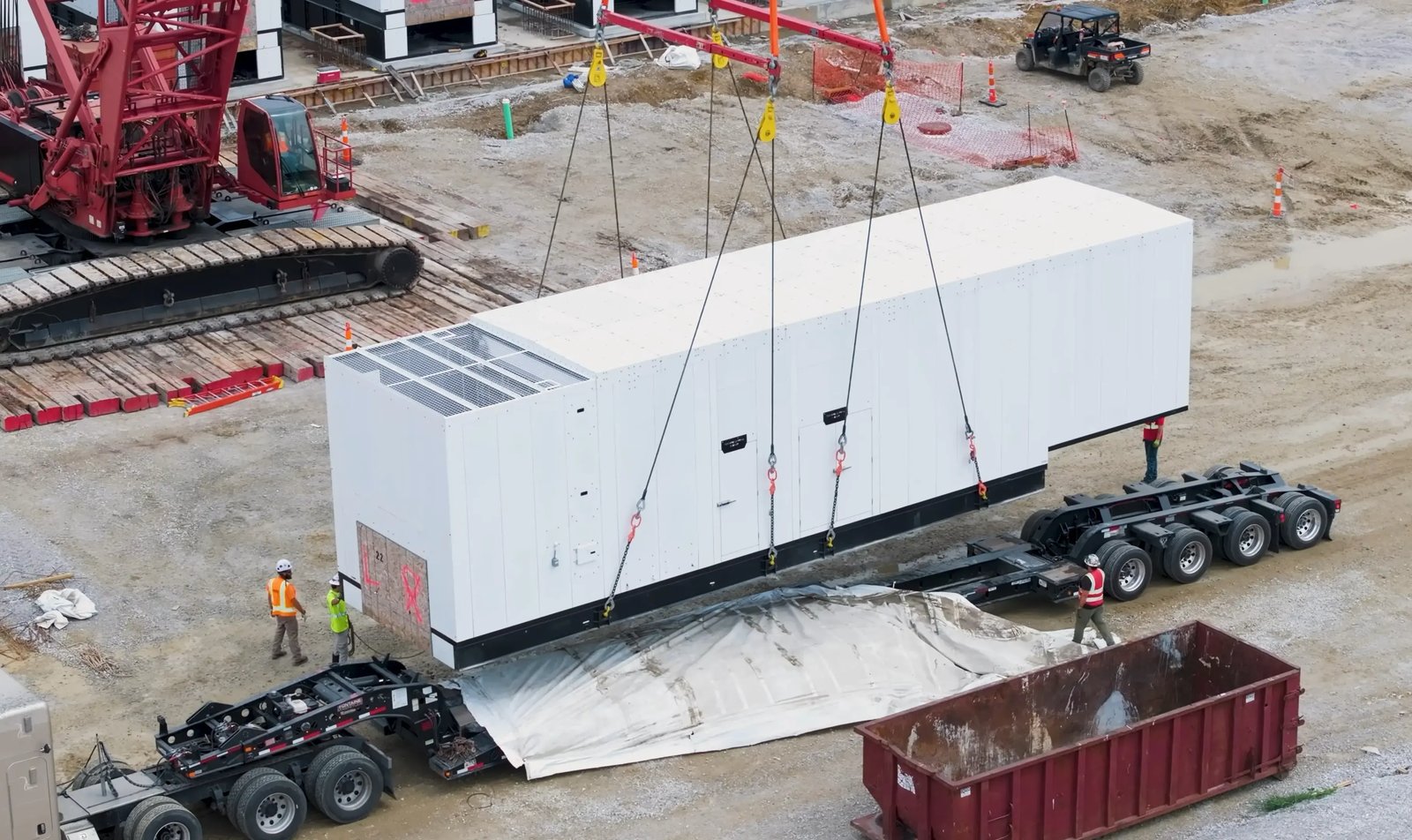
The result is a market in which lead times for essential equipment can extend well beyond a year..png?width=520&height=391&name=Generator%201%20(1).png)
Recently we've coordinated the shipments of
multiple generators for a new data center build.
While extended lead times are often viewed as a procurement challenge, their impact reaches far beyond purchasing departments. In reality, they influence every stage of project delivery.
Traditionally, project schedules were largely driven by construction activities. The critical path ran through design approvals, site preparation, foundation work, structural construction, and commissioning. Today, many projects face a different reality. The critical path increasingly begins in a manufacturing facility long before construction teams arrive on site.
This shift fundamentally changes how projects must be planned and managed.
A delayed transformer can impact energization schedules. A postponed switchgear delivery can delay commissioning activities. Missed manufacturing milestones can create cascading effects that disrupt labor planning, installation sequencing, and customer handover dates.
The challenge is particularly pronounced in AI data center construction, where power requirements continue to increase. Larger electrical systems require more specialized equipment, creating even greater pressure on already constrained supply chains.
For those responsible for data center delivery, the implication is clear. Lead times are no longer merely operational concerns. They have become strategic constraints that influence the feasibility and predictability of entire projects.
Risk #2: Global Supply Chain Disruptions Continue to Threaten Data Center Construction
Modern data center construction projects rely on highly interconnected global supply networks.
A single facility may contain components sourced from dozens of countries. Critical equipment may be manufactured in one region, assembled in another, shipped through multiple transportation hubs, and ultimately delivered to a construction site thousands of miles away.
This globalized model has enabled tremendous efficiency. It has also introduced significant vulnerability.
Over the past several years, organizations have experienced firsthand how quickly global disruptions can affect project outcomes. Geopolitical tensions, trade restrictions, tariff changes, transportation bottlenecks, port congestion, and customs delays have all demonstrated the fragility of international supply networks.
For many project teams, the challenge is not simply that disruptions occur. The challenge is that they often become visible too late.
A supplier may encounter production issues months before the impact becomes apparent to the project team. A shipment may face delays at a port while downstream stakeholders continue operating under outdated assumptions. Critical milestones can remain unchanged on project schedules even when the underlying supply chain realities have already shifted.
As data center projects become increasingly dependent on global sourcing, resilience becomes just as important as efficiency.
Organizations that focus exclusively on cost optimization often expose themselves to unnecessary risk. Those that invest in visibility, supplier relationships, contingency planning, and alternative sourcing strategies are generally better positioned to respond when disruptions occur.
Risk #3: Fragmented Stakeholder Coordination Is Creating Hidden Project Risks
One of the most underestimated challenges in data center construction is the complexity of stakeholder coordination.
A large-scale project typically involves developers, architects, engineers, equipment manufacturers, logistics providers, general contractors, commissioning specialists, utility companies, and installation teams. Each stakeholder plays a critical role. Each operates with its own priorities, systems, processes, and reporting structures.
Individually, these organizations may perform exceptionally well.
Collectively, however, fragmentation often creates significant challenges.
Information becomes distributed across multiple systems. Decisions are made based on incomplete data. Teams develop different interpretations of project status. Critical issues are communicated through emails, spreadsheets, meetings, and phone calls, making it difficult to maintain a single source of truth.
The consequence is that problems frequently emerge not because stakeholders lack competence, but because stakeholders lack alignment.
A supplier may assume installation readiness while site conditions remain incomplete. Logistics providers may schedule deliveries based on outdated project milestones. Procurement teams may secure materials without visibility into changing construction requirements.
These disconnects create inefficiencies that are difficult to identify and even more difficult to resolve.
Many data center construction delays are ultimately coordination failures rather than execution failures.
Risk #4: Data Center Construction Materials Are Becoming a Strategic Constraint
The availability of data center construction materials is increasingly shaping project outcomes.
For decades, construction organizations operated within a relatively predictable procurement environment. Materials could generally be sourced when needed, and competition for manufacturing capacity remained manageable.
That environment has changed.
The growth of hyperscale data center construction has created unprecedented demand for electrical infrastructure, cooling systems, structural materials, cable assemblies, and prefabricated components. At the same time, broader investments in renewable energy, industrial manufacturing, and infrastructure modernization are competing for many of the same resources.
The result is a global competition for capacity.
This is an important distinction. Organizations are no longer simply competing for projects. They are competing for access to the manufacturing resources required to execute those projects.
In many categories, availability has become just as important as cost.
This shift forces project teams to think differently about planning. Decisions that were once made during procurement now influence strategic project design. Material availability may affect sequencing decisions, installation approaches, supplier selection, and even the overall project timeline.
Forward-looking organizations increasingly recognize that supply chain constraints must be considered during the earliest phases of project development.
Waiting until construction begins to address material risks is becoming an increasingly expensive strategy.
Risk #5: Why Traditional Data Center Procurement Strategies Are No Longer Enough
The role of procurement is undergoing a significant transformation.
Historically, procurement functions focused heavily on cost management. Success was often measured through negotiated savings, competitive bidding outcomes, and purchasing efficiency.
Those objectives remain important. However, they are no longer sufficient in today's environment.
Within complex data center projects, procurement decisions directly influence schedule performance, supply chain resilience, and execution certainty. The lowest-cost supplier is not always the supplier best positioned to support project success.
A supplier offering a lower purchase price may carry significantly greater risks related to manufacturing capacity, delivery reliability, or operational resilience.
As a result, leading organizations are redefining what constitutes an effective data center procurement strategy.
Rather than focusing exclusively on transactional purchasing, they are emphasizing strategic supplier relationships, early supplier engagement, capacity reservations, and long-term collaboration.
The conversation is gradually shifting from price optimization toward risk optimization.
This evolution reflects a broader understanding of project economics. A seemingly small procurement saving can quickly become insignificant when compared to the cost of delayed commissioning, idle labor, expedited freight, or postponed revenue generation.
Procurement is no longer simply about buying materials.
It is increasingly about securing the conditions necessary for successful project execution.
Risk #6: Data Center Construction Logistics Are Becoming More Complex
Even when materials are available and suppliers perform as expected, projects can still encounter significant challenges during the final stages of delivery.
Data center construction logistics has become a discipline in its own right.
Large projects often require thousands of deliveries to arrive at precisely the right moment. Deliveries that arrive too early create storage challenges and increase the risk of damage. Deliveries that arrive too late can halt installation activities and disrupt carefully coordinated schedules.
This balancing act becomes increasingly difficult as project complexity increases.
Modern data center facilities often operate within highly constrained construction environments. Site access may be limited. Storage capacity may be restricted. Multiple contractors may require access to the same work areas simultaneously.
Without effective planning, these conditions can quickly create bottlenecks.
Successful data center project logistics requires far more than transportation management. It requires synchronization between procurement schedules, supplier production timelines, transportation networks, site readiness, installation sequencing, and labor availability.
In many respects, logistics serves as the bridge between planning and execution.
When that bridge functions effectively, projects maintain momentum. When it fails, even minor disruptions can have consequences throughout the broader project schedule.
Risk #7: Limited End-to-End Visibility Is Delaying Better Decisions
Despite significant investments in technology, many organizations still struggle to achieve true end-to-end visibility across the data center supply chain.
Information often remains fragmented across procurement systems, project management tools, spreadsheets, supplier portals, transportation platforms, and email communications.
Each system provides a partial view of reality.
Very few provide a complete picture.
This creates a dangerous gap between what is happening and what decision-makers believe is happening.
The consequences become particularly severe when projects encounter unexpected disruptions. Without a comprehensive view of supplier performance, shipment status, project dependencies, and critical path activities, organizations are forced into reactive decision-making.
Problems are addressed after they occur rather than before.
The industry has made significant progress in improving visibility. However, visibility itself should not be viewed as the ultimate objective.
Knowing where a shipment is located provides value.
Understanding how that shipment could affect future project milestones provides even greater value.
The next frontier for the industry lies in moving beyond visibility toward predictability.
Organizations that can identify risks before they materialize, evaluate alternative scenarios, and proactively coordinate responses will be far better positioned to maintain schedule certainty in an increasingly complex environment.
Why AI Data Center Construction Is Amplifying Every Supply Chain Challenge
The rise of artificial intelligence is not simply increasing demand for data centers. It is fundamentally changing the requirements of the facilities being built. AI workloads require significantly higher power densities, more advanced cooling infrastructure, and larger electrical systems than traditional data center environments. As a result, demand for critical equipment such as transformers, switchgear, generators, and liquid cooling solutions is growing at a pace that many supply chains struggle to support.
This trend is accelerating pressure across the entire data center supply chain. Components that were already experiencing long lead times are becoming even harder to secure, while the scale of hyperscale data center construction continues to increase. Projects are no longer measured in tens of megawatts, but increasingly in hundreds of megawatts or even gigawatt-scale campuses designed to support future AI growth.
The challenge is that supply chains cannot expand as quickly as demand. Manufacturing capacity, transportation networks, and specialized supplier ecosystems all require significant time and investment to scale. As a result, AI is amplifying many of the risks already facing the industry, including longer lead times, material shortages, procurement complexity, and logistics constraints.
For construction leaders, the implication is clear. AI data center construction is not creating an entirely new set of supply chain challenges. It is intensifying the ones that already exist. Organizations that proactively secure capacity, strengthen supplier relationships, and improve visibility across their supply chains will be far better positioned to deliver projects predictably as demand continues to grow.
The Future of the Data Center Supply Chain: From Coordination to Orchestration
As data center projects become larger and more complex, traditional approaches to project coordination are reaching their limits. Modern projects involve hundreds of stakeholders, global supplier networks, long manufacturing lead times, and countless interdependencies that can influence project outcomes. In this environment, success is no longer determined by how well individual activities are managed, but by how effectively the entire ecosystem is aligned.
This is why the industry is gradually shifting from coordination to orchestration. Coordination focuses on managing tasks, deliveries, and milestones. Orchestration focuses on managing outcomes. It connects procurement, logistics, suppliers, contractors, and project teams around a shared understanding of priorities, risks, and dependencies.
The foundation of this shift starts with visibility. Organizations need access to accurate and timely information across the supply chain. However, visibility alone is no longer enough. Leading organizations are increasingly focused on generating insight from that information, developing foresight into potential disruptions, and ultimately orchestrating decisions across multiple stakeholders before issues impact project delivery.
As AI infrastructure investments continue to accelerate and supply chains become more interconnected, the ability to create predictability will become a significant competitive advantage. The organizations that consistently deliver successful projects will not necessarily be those with the largest budgets or the most resources, but those that can align complex ecosystems and make informed decisions faster than their competitors.