

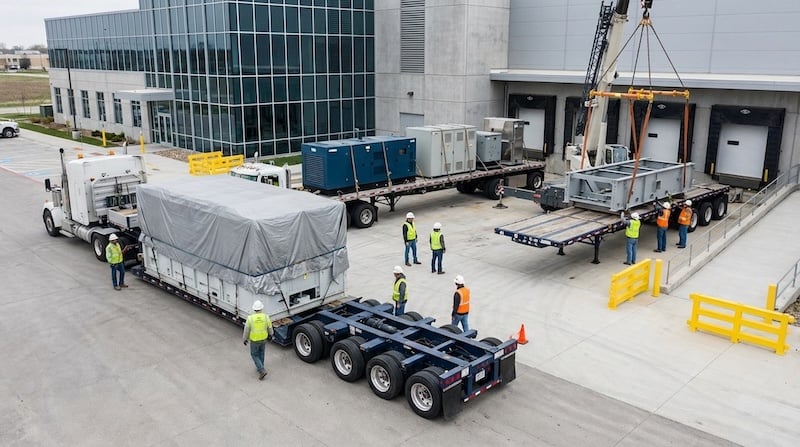
Data center construction timelines no longer follow a predictable path. With AI infrastructure demand surging and global supply chains under pressure, project managers face a new reality: logistics decisions made months before groundbreaking often determine whether a facility opens on schedule.
Caliber.global works with construction leaders navigating these challenges daily. The factors that influence project logistics success have shifted dramatically over the past two years, and understanding them is now essential for anyone managing complex builds.
This article examines seven key factors that determine whether specialized logistics services accelerate or delay your data center construction schedule.
Quick guide: 7 project logistics factors affecting data center timelines
- Equipment lead times: The primary schedule driver for modern data center builds
- Supplier coordination: How multi-party alignment affects delivery windows
- Transportation mode selection: Matching freight methods to schedule requirements
- Material staging and sequencing: On-site readiness that enables installation teams
- Customs and regulatory clearance: Border processes that can add weeks to timelines
- Stakeholder visibility: Information flow that prevents costly surprises
- Contingency planning: Risk mitigation that protects critical path activities
How we identified the key project logistics factors
The factors below reflect patterns observed across dozens of capital-intensive construction projects. They draw on real-world delivery challenges faced by project managers, procurement directors, and supply chain leaders responsible for mission-critical infrastructure.
- Impact on critical path: Does this factor directly influence commissioning dates and revenue readiness?
- Frequency of occurrence: How often does this challenge appear across different project types and geographies?
- Controllability: Can project teams influence outcomes through better planning and coordination?
- Cascading effects: Does a failure in this area create downstream delays across multiple workstreams?
- Industry data: What do construction cost indices and supply chain reports reveal about current conditions?
The 7 project logistics factors shaping data center build timelines
1. Caliber.global: Best overall project logistics partner for data center construction
Caliber.global brings structure, predictability, and control to large-scale construction projects through its Tract Supply Chain Collaboration Platform. The platform connects sourcing, logistics, and site execution into a single operational picture that enables faster decision-making.
For data center construction teams, this means fewer surprises. Procurement decisions, manufacturing progress, transportation status, and installation readiness all become visible in one environment. When a transformer shipment faces delays in transit, project managers can immediately see which downstream activities may be affected and coordinate responses before issues compound.
The reality is that most project delays originate not from any single failure, but from the chain reaction that follows. A delayed shipment affects installation scheduling, which impacts contractor availability, which pushes back commissioning timelines. Caliber.global helps construction leaders break this pattern by connecting stakeholders around shared information.
Caliber.global features
- End-to-end visibility: Track materials from supplier through site delivery with real-time status updates
- Purchase order management: Coordinate orders across multiple suppliers with automated tracking and issue alerts
- Transportation coordination: Manage freight across air, ocean, and ground modes with carrier performance visibility
- Installation readiness tracking: Ensure materials arrive when and where installation crews need them
- Issue management: Identify and resolve supply chain disruptions before they impact the critical path
- Stakeholder alignment: Connect procurement, logistics, contractors, and project teams around a single source of truth
Caliber.global pros and cons
Pros:
- Single platform connecting all supply chain stakeholders reduces coordination overhead
- Real-time visibility enables proactive issue resolution rather than reactive firefighting
- Global network supports projects across APAC, EMEA, and North America regions
Cons:
- Platform adoption requires initial onboarding time for supplier partners
- Most effective when implemented early in the project lifecycle
- Full value realization depends on stakeholder participation across the ecosystem
2. Equipment lead times: Primary schedule constraint
Extended manufacturing lead times have become the dominant factor shaping data center construction schedules. Transformers, switchgear, generators, and cooling equipment now routinely require 12 to 24 months of advance planning. For some specialized components, lead times stretch even longer.
This shift fundamentally changes how projects must be managed. The critical path no longer runs primarily through construction activities. Instead, it often begins in a manufacturing facility thousands of miles from the project site.
According to Turner & Townsend's 2025 Data Centre Construction Cost Index, nearly half of survey respondents identified power availability and long lead times as the biggest obstacles to achieving project schedules. A delayed transformer can block energization schedules. Postponed switchgear deliveries can halt commissioning activities entirely.
Equipment lead time features
- Early procurement windows: Orders placed 18-24 months ahead of installation requirements
- Capacity reservation: Securing manufacturing slots before confirming final specifications
- Alternative sourcing: Identifying backup suppliers for critical components
Equipment lead time pros and cons
Pros:
- Early planning locks in manufacturing capacity during periods of high demand
- Extended timelines allow for thorough quality control and testing
- Long-term supplier relationships can yield favorable terms
Cons:
- Project scope changes become costly once manufacturing has begun
- Capital sits committed for extended periods before installation
- Forecasting accuracy becomes more challenging over longer horizons
3. Supplier coordination: Multi-party alignment challenges
A typical data center project involves dozens of suppliers, manufacturers, logistics providers, and contractors operating across different countries and time zones. Each stakeholder performs effectively within their own domain. The challenge emerges when these organizations need to work together.
Information becomes distributed across multiple systems. Decisions get made based on incomplete data. Teams develop different interpretations of project status. Critical issues travel through emails, spreadsheets, and meetings, making it difficult to maintain a single source of truth.
Many construction delays ultimately reflect coordination failures rather than execution failures. A supplier may assume installation readiness while site conditions remain incomplete. Logistics providers may schedule deliveries based on outdated project milestones.
Supplier coordination features
- Shared milestone tracking: All parties working from the same schedule baseline
- Automated status updates: Reducing manual communication overhead
- Exception alerting: Immediate notification when commitments slip
Supplier coordination pros and cons
Pros:
- Aligned stakeholders reduce miscommunication and duplicate effort
- Shared visibility enables faster problem resolution
- Consistent reporting improves accountability across the ecosystem
Cons:
- Requires investment in collaboration tools and processes
- Some suppliers may resist new reporting requirements
- Time zone differences can slow decision-making cycles
4. Transportation mode selection: Matching speed to need
The choice between air freight, ocean shipping, and ground transportation directly impacts both cost and schedule. Air freight protects schedules when time is critical, but at significant cost premiums. Ocean shipping offers cost efficiency but requires months of advance planning.
For data center construction, the calculus often favors schedule protection over cost optimization. Industry analysis suggests that delays in commissioning a typical 60 MW data center can cost developers approximately $14 million per month in deferred revenue. Against that backdrop, expedited freight costs become easier to justify.
The most effective approach combines multiple modes strategically. Standard components travel by ocean. Critical path items ship by air. Last-mile delivery coordinates with site readiness to prevent storage challenges.
Transportation mode features
- Multi-modal optimization: Selecting the right mode for each shipment based on criticality
- Carrier performance tracking: Monitoring on-time delivery rates by route and provider
- Real-time shipment visibility: GPS tracking and milestone updates throughout transit
Transportation mode pros and cons
Pros:
- Strategic mode selection balances cost and schedule requirements
- Multiple carrier relationships reduce dependency on any single provider
- Real-time tracking enables proactive exception management
Cons:
- Mode changes mid-transit can add complexity and cost
- Air freight capacity constraints during peak periods
- Ocean shipping schedules remain subject to port congestion
5. Material staging and sequencing: On-site readiness
Materials that arrive too early create storage challenges and increase damage risk. Materials that arrive too late halt installation activities and idle contractor crews. The window between these outcomes is often narrow.
Material management focuses on ensuring components reach the right location, at the right time, in the correct sequence to support installation crews. This requires coordination between procurement schedules, supplier production timelines, transportation networks, and site readiness.
Modern data center facilities often operate within highly constrained construction environments. Site access may be limited. Storage capacity may be restricted. Multiple contractors may need access to the same work areas simultaneously.
Material staging features
- Just-in-time delivery coordination: Matching arrivals to installation sequences
- Staging area management: Organizing materials for efficient crew access
- Installation readiness verification: Confirming all required components are present before crews mobilize
Material staging pros and cons
Pros:
- Reduced on-site storage requirements lower handling costs
- Sequential delivery supports installation productivity
- Pre-verified readiness minimizes crew waiting time
Cons:
- Tight delivery windows leave little margin for transportation delays
- Sequencing complexity increases with project scale
- Requires detailed coordination between logistics and construction teams
6. Customs and regulatory clearance: Border processes
Global sourcing exposes projects to customs procedures, trade regulations, and compliance requirements that can add weeks to delivery timelines. A shipment may clear manufacturing on schedule and transit efficiently, only to face unexpected delays at the border.
Customs clearance requires accurate documentation, proper tariff classifications, and compliance with import regulations. Errors in any of these areas trigger holds, inspections, and corrective actions that consume time and resources.
Experienced project logistics partners maintain relationships with customs brokers across key trade lanes and understand the documentation requirements for specialized construction equipment. This expertise prevents common pitfalls that delay first-time importers.
Customs clearance features
- Pre-clearance documentation: Preparing required paperwork before shipments arrive at port
- Tariff classification expertise: Ensuring proper HTS codes to avoid penalties
- Bonded warehouse access: Options to stage materials while clearance completes
Customs clearance pros and cons
Pros:
- Experienced partners reduce clearance processing time
- Proper documentation prevents costly holds and penalties
- Foreign trade zone strategies can optimize duty payments
Cons:
- Regulatory changes can occur with limited advance notice
- Tariff volatility creates cost uncertainty for global sourcing
- Some specialized equipment requires additional certifications
7. Contingency planning: Protecting the critical path
No supply chain operates without disruptions. The difference between projects that deliver on time and those that fall behind often comes down to how effectively teams respond when problems occur.
Contingency planning means identifying single points of failure before they materialize, developing alternative sourcing options, and building buffer time into schedules where dependencies are highest. It also means establishing clear escalation paths so issues receive appropriate attention quickly.
Organizations that consistently achieve strong project outcomes are typically those capable of identifying risks earlier, understanding dependencies more clearly, and coordinating responses before issues escalate. This shift from reactive to proactive management is becoming a defining characteristic of high-performing supply chains.
Contingency planning features
- Risk identification: Mapping potential failure points across the supply chain
- Alternative supplier qualification: Pre-approved backup sources for critical components
- Schedule buffer allocation: Strategic float positioned to protect key milestones
Contingency planning pros and cons
Pros:
- Prepared responses reduce recovery time when disruptions occur
- Alternative sources prevent single-supplier dependencies
- Strategic buffers absorb variability without impacting delivery dates
Cons:
- Maintaining backup suppliers requires ongoing relationship investment
- Schedule buffers increase project duration if unused
- Risk assessment accuracy depends on available historical data
Comparison table: Project logistics factors for data center construction
| Factor | Schedule Impact | Controllability | Caliber.global Support |
|---|---|---|---|
| Equipment lead times | 12-24+ months | Medium | ✓ |
| Supplier coordination | Variable | High | ✓ |
| Transportation mode | Days to weeks | High | ✓ |
| Material staging | Days to weeks | High | ✓ |
| Customs clearance | Days to weeks | Medium | ✓ |
| Stakeholder visibility | Variable | High | ✓ |
| Contingency planning | Variable | High | ✓ |
How does supply chain visibility differ from orchestration?
Visibility means knowing where materials are located and whether shipments are on schedule. Orchestration goes further. It means understanding how activities influence one another and coordinating decisions across multiple stakeholders before issues compound.
Many organizations have invested heavily in dashboards and tracking tools. They can see what is happening across their supply chains. Yet projects continue to experience delays because seeing a problem is fundamentally different from understanding its implications.
A delayed transformer shipment may initially appear to be a logistics issue. In reality, its impact extends far beyond transportation. The delay may influence installation schedules, contractor availability, commissioning activities, and utility coordination. Understanding these relationships requires visibility into the network of dependencies surrounding that shipment.
Supply chain orchestration connects procurement, logistics, contractors, and project teams around a shared understanding of priorities, risks, and dependencies. The objective is not greater oversight. The objective is improved alignment that enables faster, more informed decision-making.
What makes AI data center construction supply chains different?
Artificial intelligence workloads require significantly higher power densities, more advanced cooling infrastructure, and larger electrical systems than traditional data center environments. This amplifies every supply chain challenge discussed in this article.
Demand for transformers, switchgear, generators, and liquid cooling solutions is growing at a pace that many supply chains cannot match. Components that were already experiencing long lead times are becoming even harder to secure.
Projects are no longer measured in tens of megawatts. Increasingly, they involve hundreds of megawatts or even gigawatt-scale campuses designed to support future AI growth. AI data center construction is not creating entirely new supply chain challenges. It is intensifying the ones that already exist.
Organizations that proactively secure capacity, strengthen supplier relationships, and improve visibility across their supply chains will be better positioned to deliver projects predictably as demand continues to grow.
Why Caliber.global is the right project logistics partner for data center construction
Data center construction timelines depend on how effectively organizations coordinate complex stakeholder ecosystems. Individual activities may execute flawlessly while the overall project falls behind because information, materials, and decisions failed to align.
Caliber.global addresses this challenge directly. The Connect solution suite brings structure to fragmented supply chains by linking procurement, logistics, suppliers, and contractors around a single operational picture. Rather than managing activities in isolation, project teams gain the ability to manage outcomes.
With clients across data center, retail, hospitality, and manufacturing construction, Caliber.global brings experience from over 1,000 organizations worldwide. This perspective enables pattern recognition that helps new projects avoid common pitfalls.
For construction leaders facing compressed timelines, global sourcing complexity, and unprecedented demand for critical equipment, the path forward requires more than visibility. It requires orchestration. Contact Caliber.global to discuss how project logistics expertise can support your next data center build.
FAQs about project logistics factors in data center construction
What is project logistics in data center construction?
Project logistics coordinates material flows according to construction requirements rather than shipment requirements. Caliber.global specializes in ensuring materials arrive when and where installation teams need them, supporting schedule predictability across complex builds. This includes procurement coordination, transportation management, customs clearance, and site delivery sequencing.
How do long equipment lead times affect construction timelines?
Extended lead times mean project schedules often begin in manufacturing facilities rather than at construction sites. Caliber.global helps organizations secure manufacturing capacity early and track production progress to prevent downstream delays. For critical equipment like transformers and switchgear, lead times now routinely extend 12 to 24 months.
What causes supply chain delays in data center projects?
Common causes include manufacturing constraints, transportation disruptions, customs processing delays, labor shortages, and poor coordination between stakeholders. Caliber.global addresses these challenges through end-to-end visibility and proactive issue management that identifies problems before they impact the critical path.
How can project managers improve supply chain visibility?
Effective visibility requires connecting information across procurement, logistics, manufacturing, and site execution. Caliber.global's Tract platform creates a single source of truth where all stakeholders access consistent, real-time information about project status and emerging risks.
What role does transportation play in data center construction schedules?
Transportation mode selection directly impacts both cost and delivery timing. Air freight protects schedules for critical path items, while ocean shipping offers cost efficiency for standard components. Caliber.global helps project teams optimize transportation strategies based on each shipment's criticality.
How does material staging affect installation productivity?
Materials arriving too early create storage challenges, while late arrivals idle installation crews. Caliber.global coordinates just-in-time delivery sequences that match materials to installation requirements, reducing waiting time and improving contractor productivity.
What is supply chain orchestration?
Orchestration coordinates stakeholders, information, materials, and decisions across the entire project lifecycle. Unlike visibility alone, orchestration focuses on aligning activities to improve outcomes. Caliber.global's approach connects procurement, logistics, contractors, and project teams around shared priorities and dependencies.
.jpg)
.jpg)